Sensation before meaning.
Notice breath, movement, stillness, and expression without deciding what they mean. Ask. Listen. Let the client remain the author of their experience.
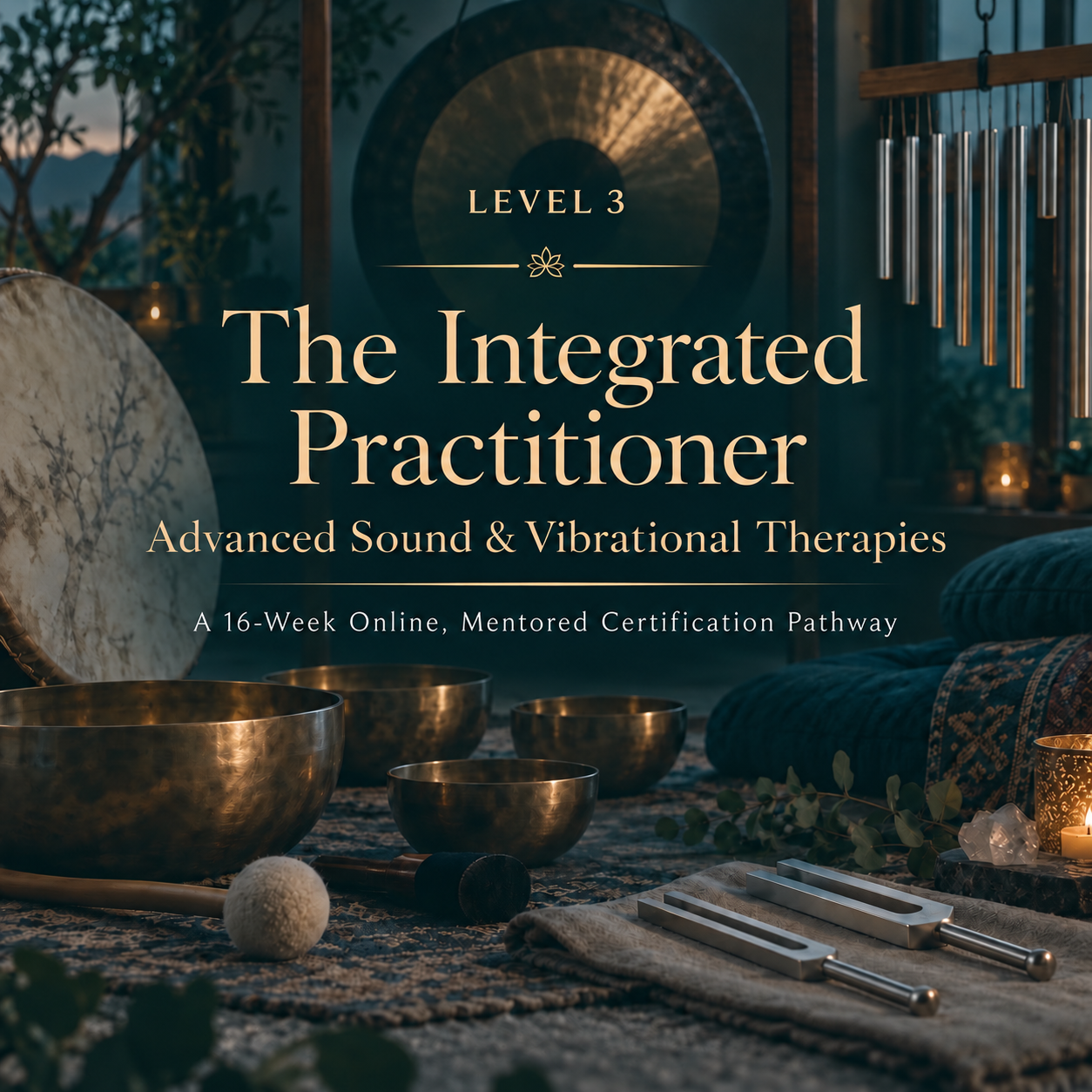
Level 3Presence. Practice. Integration.
A 16-week online, mentored pathway in holding space, trance-informed practice, Nidra, voice, and professional practice.
You’ve learned to work with sound and vibration.
Now learn to bring it all together.
Next cohort dates to be announced
The next step is not simply more.
There comes a point when another instrument or another protocol is not the answer to the question you are really asking.
How do I bring what I know into a session that responds to the person in front of me?
Level 3 is where technique meets presence. Where a plan becomes a conversation. Where sound, vibration, voice, mindful awareness, and silence begin to feel less like separate tools—and more like a thoughtful, integrated practice.
Level 1 · Sound
Build your foundation in sound and the art of offering an experience.
Level 2 · Vibration
Explore vibration, the body, and the responsibility of hands-on practice.
Level 3 · Integration
Develop the discernment to respond to the whole person, within your role.
The deeper art of holding space
Advanced practice asks for more than a well-played instrument. It asks how we listen, how we offer choice, and how we respond when a session unfolds differently than expected.
Sometimes the most advanced thing you can do
is pause.
Notice breath, movement, stillness, and expression without deciding what they mean. Ask. Listen. Let the client remain the author of their experience.
Deepen your approach to consent, pacing, boundaries, and trauma-informed facilitation. Make room for less sound, a different position, open eyes, or a pause.
Support another person without chasing a breakthrough. Learn when to adapt, when to stop, and when their needs call for support beyond your scope.
Your 16-week learning journey
Each movement builds on the one before it, with time to learn, experience, practice, and return with better questions. Open a week to explore its focus.
Weeks 1–4 · THE PRACTITIONER
Begin with the person holding the instruments. Develop the presence, discernment, and steadiness that make thoughtful practice possible.
Practicum one · Presence, pacing & holding space
The practitioner becomes the instrument. Revisit listening before doing, regulation before resonance, the Sacred Pause, and the Three Sacred A’s: Awareness, Allowing, and Acceptance. Explore your own expectations and the difference between offering support and trying to produce an experience.
Practice & reflectNotice where you feel the urge to do more. Practice a simple session in which listening and pause are part of the plan.
Explore consent as an ongoing conversation, client choice, boundaries, pacing, emotional expression, and the limits of your role. Learn to support an experience without labeling it, interpreting a client’s story, or presenting yourself as a mental-health professional.
Practice & reflectRehearse offering choices, checking consent, pausing a session, and responding when a client asks for less.
Attend to breathing, posture, expression, movement, stillness, and responsiveness without treating any single cue as a diagnosis. Learn to ask rather than assume, and to distinguish what you observed from the meaning you were tempted to attach to it.
Practice & reflectWrite an observation-based reflection. Separate what you noticed, what the client reported, and what remains unknown.
Build a purposeful arc: arrival, listening, intention, regulation, exploration, integration, and return. Use the structure of your foundational training while learning to adapt it within consent, established safety boundaries, and your scope.
Practice & reflectComplete your first practicum, reflecting on presence, pacing, choices, and what you changed from your original plan.
Weeks 5–8 · TRANCE & NIDRA
Explore attention, rest, language, and awareness through a trance-informed lens—and experience Meditate’s three complementary approaches to Nidra.
Practicum two · A 20–30 minute Nidra-inspired practice
Explore everyday absorption, focused attention, relaxation, meditation, and the responsibilities of a trance-informed practitioner. Study invitational language, non-leading suggestion, orientation, and return. The emphasis is on client agency, not control or uncovering hidden memories.
Practice & reflectReview a short guidance script. Replace assumptions and leading statements with choices, permission, and clear invitations.
Explore intention, rotation of awareness, breath, witnessing, and a considered return. Consider the place of imagery and opposites, how approaches differ, and how to offer alternatives when inward focus is uncomfortable.
Practice & reflectExperience a guided practice and begin drafting a short, choice-centered facilitation.
Explore our approach to weaving bowls, gong, voice, drone, and silence into the structure of a Nidra practice. Work with transitions, restraint, and the relationship between spoken guidance and listening rather than simply adding instruments behind a script.
Practice & reflectDesign a practice in which each sound has a clear purpose—and silence has room to do its work.
Explore the SVMT-informed integration of mindful awareness, somatic listening, breath, sound, vibration, and silence. Keep contact-based work within your previous training and obtain specific consent. Experience all three approaches, then choose one for your practicum.
Practice & reflectFacilitate a 20–30 minute Nidra-inspired experience and reflect on language, pacing, client choice, and return.
Weeks 9–12 · VOICE & INTEGRATION
Bring your voice into the room and begin weaving your existing tools into a coherent, responsive practice. Integration does not mean using everything at once.
Practicum three · An integrated 45-minute session
Begin the included Welcome to Your Voice course. Explore breath, humming, toning, vowel sounds, and authentic expression without making performance the goal. Meet the hesitation that can arise when the instrument is not in your hands—it is you.
Practice & reflectDevelop a gentle personal voice practice. Stay within a comfortable range and leave effort, strain, and comparison out of it.
Continue Welcome to Your Voice through spoken guidance, sustained tones, shared vocal invitations, and voice alongside instruments. Explore consent around participation, the cultural context of practices you use, and when voice supports a session or silence serves it better.
Practice & reflectCreate a brief vocal invitation and an equally welcoming alternative for someone who prefers to listen.
Refine your use of gong, drum, singing bowls, rhythm, voice, and silence. Explore dynamic arcs, layering, transitions, and restraint. Choose instruments in response to the session’s purpose rather than to demonstrate everything you own.
Practice & reflectPlan a sound sequence with deliberate changes in texture and intensity, including a clear arrival and return.
Build on Level 2 through thoughtful combinations of tuning forks, bowls, off-body sound, somatic awareness, and stillness. Adapt within established protocols, precautions, and consent. This is integration of prior skills, not authorization to improvise beyond your training.
Practice & reflectComplete a 45-minute integrated session. Submit the original plan alongside what you actually did, what changed, and why.
Weeks 13–16 · PROFESSIONAL PRACTICE
Bring the same care to the inquiry, intake, follow-up, and business relationship that you bring to the session itself.
Final integration · Your signature session & practitioner portfolio
Develop a welcoming intake conversation around goals, expectations, sensitivities, relevant considerations, and consent. Explore documentation, confidentiality, touch boundaries, scope, and when a request calls for referral rather than a session.
Practice & reflectDraft an intake and consent process, then practice the conversation. Intake is the beginning of a relationship, not an interrogation.
Explore session closure, orientation, client-led reflection, appropriate documentation, and permission-based follow-up. Practice listening to a client’s account without assigning meaning to it, making promises, or encouraging dependence.
Practice & reflectWrite a follow-up message that is caring, clear, and free of pressure to rebook.
Clarify what you offer and who it is for. Introduce pricing, scheduling, policies, professional coverage, ethical marketing, testimonials, online presence, and possible community partnerships. Explore practical questions to take to qualified local business advisers.
Practice & reflectCreate a one-page practice plan with a clear offering, a simple client journey, and your next realistic steps.
Bring the pathway together through your practitioner statement, scope statement, intake and follow-up process, and a final signature session. Reflect on how you have changed, what you do well, and where you need further learning or mentoring.
Practice & reflectSubmit your 60-minute signature-session work and final reflection. Demonstrate how you listen, choose, adapt, and work responsibly.
A trance-informed perspective
Explore attention, absorption, language, and return without making trance mysterious or taking choice away. Experience all three Nidra approaches, then develop a practice of your own.
Awareness & guided attention
Awareness within deep rest.
Explore intention, body awareness, breath, witnessing, and thoughtful return. Honor the traditions that inform the practice while acknowledging the different ways it is taught.
Listening & spaciousness
When sound becomes a guide.
In our approach, instruments are not simply background to a script. Explore how voice, bowls, gong, drone, and silence can become part of the structure of a listening practice.
Sensation & relationship
Resting in relationship with the body.
Explore Meditate’s SVMT-informed integration of somatic listening, mindful awareness, sound, vibration, breath, and silence, with consent and established practice boundaries throughout.
This is not a hypnosis certification or training to treat trauma. Level 3 develops foundational Nidra integration within sound and vibrational practice; the deeper, stand-alone Nidra certification remains a separate specialty pathway.
Before the bowl.
Before the gong.
Before the drum.
There was you.
Meet one of the most personal instruments available to you. Explore humming, toning, breath, sustained sound, and spoken guidance—not to become a performer, but to become more comfortable with your own expression.
Nobody is auditioning for The Voice.
Nobody is turning their chair around.
Learn how voice can sit alongside bowls, gong, and drum. Discover when it supports a session, how to invite participation without pressure, and when silence is the better choice.
Online does not mean learning alone
Recorded teachings with Bill give you a place to begin. Guided experiences, personal reflection, practice sessions, and live mentoring help you turn information into understanding.
You are not expected to arrive with every answer. You are invited to arrive willing to notice, ask, and practice again.
Certification is based on participation, practical work, and demonstrated competency—not simply on finishing the videos. Consent, scope, thoughtful choices, and honest reflection matter throughout.
Practicum 01
Demonstrate presence, pacing, consent, and a clear session arc.
Practicum 02
Develop and facilitate a 20–30 minute Nidra-inspired experience.
Practicum 03
Offer a 45-minute integrated session and explain your choices and adaptations.
Final integration
Create a 60-minute signature session with your practitioner statement and client journey.
Advanced Practitioner of Sound & Vibrational Therapies — Level 3. Awarded by Meditate upon successful completion of the course, Welcome to Your Voice, required mentoring and assessments, practicums, professional-practice exercises, and final portfolio. This is a school-issued practitioner certification, not a healthcare license. Full assessment and attendance policies will be shared before enrollment.
Professional practice, held with care
It continues after the last sound fades. Learn to bring clarity, consistency, and care to the entire client relationship.
Explore intake, expectations, sensitivities, informed consent, confidentiality, documentation, and boundaries. Make room for the person—not just the paperwork.
Practice session closure, client-led reflection, appropriate follow-up, and rebooking without pressure. Offer a relationship that supports choice rather than dependence.
Begin defining your sessions, audience, pricing, policies, scheduling, and ethical marketing. Explore how individual work, groups, and community partnerships might fit your practice.
For the practitioner ready to deepen
A note from your teacher
Founder of Meditate:
School of Mindfulness & Sound
Creator of The SVMT
Method of Transformation
I am not interested in helping you collect another hundred techniques. I am interested in what happens when you begin to trust your ability to listen—and recognize when you need to ask for guidance.
That does not mean throwing away your training and doing whatever feels right. It means knowing your foundations deeply enough to make thoughtful choices, stay within your scope, and remain curious about the human being in front of you.
The goal is not for you to leave practicing exactly like me.
The goal is for you to discover how you practice.
We will bring study and experience together. We will ask questions. We will practice. We will probably laugh. And we will keep returning to the understanding that this work is not a performance. It is a relationship.
Your next chapter of practice
Both tuition options include the same 16-week mentored pathway, Welcome to Your Voice, the three Nidra perspectives, practical assignments, and professional-practice foundations.
Standard tuition
USD · Total course tuition
For eligible practitioners ready to continue from their Level 1 and Level 2 foundations.
Sixteen weeks of study and integration, eight live mentoring circles, and practicum-based learning.
Review detailsSVMT Community Tuition
USD · Total course tuition
For current students and graduates of The SVMT Method of Transformation.
The complete Level 3 experience, with community tuition that acknowledges your continuing SVMT journey.
Review detailsLevel 1 and Level 2 prerequisites apply to both options. Review the published dates, payment terms, cancellation policy, and participation requirements before enrolling.
Secure Your Spot
A little clarity before you begin
There is no need to have the entire journey figured out before taking the next step. Here are the foundations to help you consider whether Level 3 is the right fit.
Level 3 is designed for graduates of Meditate’s Practitioner of Sound Therapies (Level 1) and Practitioner of Vibrational Therapies (Level 2). It develops those foundations rather than replacing them. Practitioners trained elsewhere should contact Meditate before enrolling to discuss prerequisite review; equivalent training is not automatically accepted.
The teaching and mentoring pathway is online. You will also need access to your instruments, a suitable practice space, and consenting practice participants for the practical assignments. Online study does not remove the need for hands-on practice or the precautions taught in Levels 1 and 2.
The pathway is designed around eight live mentoring circles across sixteen weeks, approximately every other week. Bring questions, practice reflections, and real examples of where you felt confident or unsure. The cohort calendar, session times, and attendance expectations will be published with enrollment details.
Recording availability and any make-up arrangements will be confirmed before registration opens. Please do not assume every mentoring discussion will be recorded or that a recording automatically replaces participation. The final attendance and completion policies will be available before you enroll.
Make room each week for recorded learning, personal experience, reflection, and practice, with additional preparation for the practicums. The estimated weekly workload and length of course access will be shared with the final enrollment information; no fixed weekly-hour or lifetime-access promise is included here.
You will build on the instruments and skills used in your Level 1 and Level 2 training, including your sound and vibrational tools. You do not need to buy a room full of new instruments simply to demonstrate integration. A final equipment list and any alternatives will be provided before enrollment.
Yes. Level 3 includes experience and foundational facilitation within our Yoga Nidra, Sound Nidra, and Resonance Nidra perspectives, including a Nidra-inspired practicum. Sound Nidra and Resonance Nidra are presented as Meditate’s teaching approaches, not as claims that every school uses these names in the same way. This does not include the separate, deeper Nidra specialty certification.
No. Welcome to Your Voice is included, and the focus is authentic, comfortable expression—not singing ability or performance. You will explore humming, toning, breath, spoken guidance, and the relationship between voice and silence.
No. This is a trance-informed sound and vibrational practitioner pathway, not a hypnosis qualification, psychotherapy training, medical license, or permission to offer trauma treatment. The emphasis is informed language, consent, boundaries, and referral when a client’s needs fall outside your role.
Certification is based on completing the course requirements and demonstrating the taught competencies—not simply watching the lessons. The pathway includes Welcome to Your Voice, three practicums, mentor-reviewed reflections, professional-practice exercises, and final signature-session work. Detailed assessment, attendance, and resubmission policies will be provided before enrollment.
The SVMT Community Tuition ($995) is for current students and graduates of The SVMT Method of Transformation. Standard tuition is $1,395. Completion of Level 1 and Level 2 remains the foundation for this pathway; the community rate does not waive prerequisites.
Payment-plan options, cancellation terms, and refund policies have not yet been announced for this pathway. Those terms will be published with registration details so you can review them before making a commitment.
Level 3 includes practical foundations for intake, follow-up, defining your offering, ethical marketing, and beginning your practice. The expanded business course is a separate, optional add-on for more detailed work on branding, pricing, systems, partnerships, and growth. It is not required to earn your Level 3 certification.
Level 3 brings your foundations together. Further study can deepen a particular interest rather than asking this one program to become every certification at once. Separate pathways are not included in Level 3 tuition.
FasciaWave™ · The Three Practices of Nidra · Regression & Progression Therapies · Business development · The SVMT Method of Transformation
Level 3 · Advanced practitioner pathway
A place to listen more closely, practice more thoughtfully, and discover the practitioner you are becoming.
Cohort dates, the live mentoring schedule, and registration links will be announced here. Enrollment is not open on this page yet.
Questions about your next step? Contact Meditate.